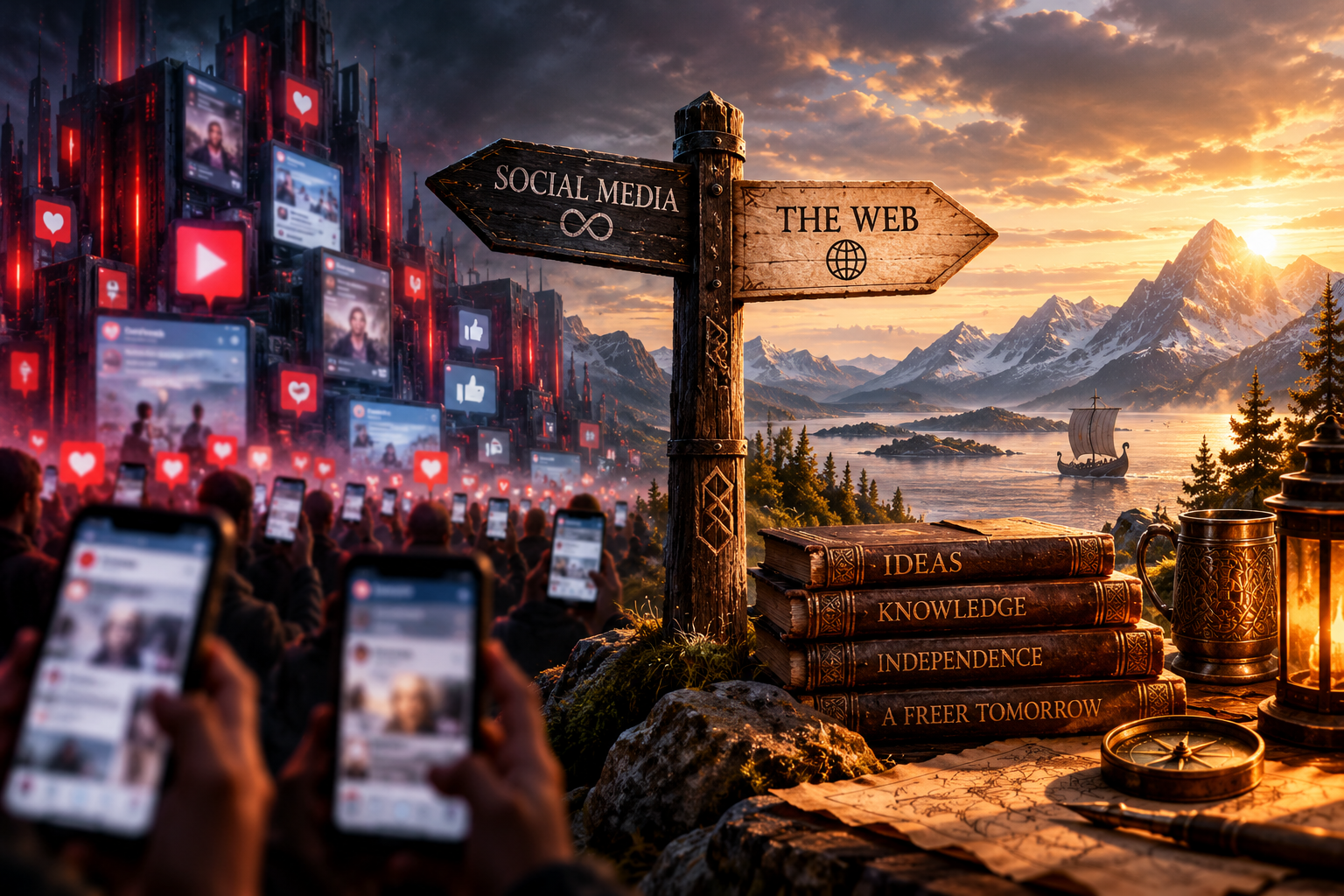
We have confused social media with the Internet.
For millions of people, publishing something online now means opening an app, typing into a box, pressing Post, and watching the response roll through a feed. We call that putting something "on the Internet."
Technically, it is.
Functionally, it often isn't.
A social-media post may be visible to hundreds, thousands, or even millions of people for a few hours. But visibility inside a platform is not the same thing as publishing something onto the open, searchable web.
The distinction matters more now than it has in years, because the machines that increasingly mediate human knowledge — search engines, crawlers, indexes, archives, aggregators, and AI retrieval systems — cannot reliably discover information that was never made available to them in the first place.
The Great Illusion of the Post
Social media creates an extraordinary illusion of publication.
You write something. People respond. Someone shares it. Notifications appear. For a few hours your words seem very much alive.
That feels like publishing.
But what you have often created is not a durable document. You have created an object inside somebody else's application.
Its visibility is controlled by a feed. Its distribution is controlled by an algorithm. Its discoverability depends on the platform's search system. Its continued existence depends on an account you do not own, running on infrastructure you do not control.
When the feed moves on, the practical life of the post may be over.
Visibility to Humans Is Not Visibility to Machines
This is where the distinction becomes important.
A human being logged into a social network may see your post perfectly well. That does not mean a search-engine crawler can see it.
Platforms can require authentication, restrict automated access, hide content behind JavaScript, limit indexing, expose only fragments of posts, or prohibit crawlers altogether.
Even when individual posts can technically be indexed, they may be poor search documents. They can lack useful page structure, stable internal links, descriptive metadata, semantic headings, clean canonical URLs, or a surrounding network of related pages.
To the person scrolling the feed, the information exists.
To a machine trying to map the public web, it may barely exist at all.
Search Engines Cannot Index What You Never Give Them
People frequently explain their absence from search results by assuming that somebody must have removed them.
Sometimes content really is removed, demoted, blocked, or excluded.
But there is a more basic problem that is easy to overlook:
If your essays live only in social posts, private groups, chat rooms, video monologues, disappearing feeds, or platforms hostile to automated crawling, there may be no conventional web document for a search engine to find.
The crawler cannot index the essay you never made into a page.
The search engine cannot rank the page that does not exist.
Other websites cannot link to a permanent document you never published.
The Publication Problem
This problem is especially severe in communities that depend heavily on alternative social-media platforms.
Enormous amounts of political, economic, philosophical, historical, and cultural discussion take place every day in environments that have weak visibility outside themselves.
Someone may spend years developing an argument, researching a subject, debating opponents, refining an idea, and writing thousands of words about it.
Yet there may be no article.
No permanent page.
No bibliography.
No indexable archive.
No site map.
No network of links connecting that person's work to related work.
The intellectual activity is real. The web presence is not.
Then people search for those ideas, fail to find them, and conclude that the search system must have erased them.
Sometimes the simpler explanation is that nobody bothered to publish them properly.
The Feed Is Designed to Forget
The web and the feed are built around fundamentally different ideas.
A web page is a destination.
A feed item is an event.
The traditional web asks: Where is this information?
The feed asks: What should this person see next?
Those are not the same problem.
A website encourages permanence. Pages accumulate. They link to one another. Old material remains accessible. Categories form. Archives grow.
A feed rewards immediacy. Yesterday's brilliant essay competes with today's meme, today's argument, today's outrage, and whatever the algorithm decides should appear next.
The system is optimized to keep information moving.
That is excellent for conversation.
It is terrible for building a library.
You Are Renting Your Audience
There is another cost to treating social media as your primary publishing system: your relationship with your audience belongs to the platform.
You may have ten thousand followers, but you do not control the mechanism that reaches those ten thousand people.
The platform can change its algorithm.
It can change its rules.
It can change its business model.
It can disappear.
Your account can disappear.
Your followers may technically remain while your ability to reach them changes overnight.
A domain is different.
When someone links to an article at your own domain, that link points to you. When a search engine indexes the page, it indexes your site. When another writer cites the article, authority can accumulate around a property you control.
Convenience Traded Away Independence
None of this happened because people suddenly decided that owning websites was bad.
Social media won because it was easy.
Building a site required hosting, HTML, design, domains, FTP, software, maintenance, and at least a small willingness to understand how the Internet worked.
Social media replaced all of that with a box:
Type. Click. Done.
The convenience was real.
But convenience had a price. Millions of people stopped being publishers and became account holders.
We traded domains for profiles, homepages for timelines, archives for feeds, hyperlinks for shares, and independent communities for audiences living inside centralized platforms.
The Wild Web Was Messy — and That Was Its Strength
The old Internet was ugly.
Personal sites had terrible fonts, blinking text, bizarre backgrounds, broken links, homemade logos, visitor counters, MIDI files, and layouts designed by people who had absolutely no business designing layouts.
It was also wonderfully decentralized.
A person with something to say could carve out a little piece of the network and make it theirs.
Thousands of strange, specialized, independent communities developed because people did not need to fit their ideas into the architecture of five enormous platforms.
The sites linked to one another.
Search engines followed those links.
Directories cataloged them.
People bookmarked them.
Archives preserved them.
That mess was not a defect of the web.
It was evidence that people actually owned pieces of it.
AI Makes Independent Publishing More Important
Search is no longer the only machine-mediated path through information.
People increasingly ask AI systems questions that they once typed into search boxes.
That does not mean publishing a webpage guarantees that a particular AI system will train on it, retrieve it, cite it, or reproduce its ideas. Training datasets, live retrieval systems, search indexes, licensing arrangements, crawler policies, and ranking systems are different things.
But they share one unavoidable prerequisite:
If your work exists as clean HTML at a permanent public address, it can be crawled, linked, archived, indexed, quoted, referenced, and retrieved by systems that are permitted to access it.
If it exists only inside a closed or poorly indexed social feed, those possibilities shrink dramatically.
In the age of AI, machine-readable publishing is not an obscure technical concern.
It is part of being heard.
Give Every Important Idea a Permanent Address
This does not mean abandoning social media.
Social media is useful.
It is excellent for conversation, discovery, networking, promotion, argument, announcements, and bringing people together.
Use it for what it is good at.
But reverse the relationship.
Instead of social media being the place where your work lives, let social media become one of the places where your work is distributed.
Write the substantial version on your website.
Give it a descriptive title.
Give it a permanent URL.
Structure it with headings.
Link it to related material.
Put it in your site's navigation.
Put it in your sitemap.
Then share that page everywhere.
Facebook becomes a distribution channel. X becomes a distribution channel. Gab becomes a distribution channel. Forums become distribution channels. Messaging groups become distribution channels.
Your website remains the source.
Links Are the Roads of the Web
The hyperlink is one of the simplest inventions in computing, and one of the most powerful.
A link tells humans where to go.
It also tells machines that two documents have a relationship.
A healthy independent web is therefore not merely a collection of isolated personal sites. It is a network.
Cite other writers.
Link directly to original sources.
Link between your own related articles.
Maintain useful indexes and category pages.
When another independent publisher writes something worth reading, send your readers there.
That is how the web becomes discoverable.
SEO Is Not Cheating
Search-engine optimization has acquired an ugly reputation because people associate it with spam, keyword stuffing, content farms, and pages written for algorithms instead of human beings.
Bad SEO deserves that reputation.
Good SEO is much less mysterious.
It means making the subject of a document clear.
- Use a descriptive page title.
- Use one clear primary heading.
- Break long arguments into meaningful sections.
- Write useful descriptions.
- Use permanent, understandable URLs.
- Link related pages together.
- Provide a sitemap.
- Make the site fast and usable on phones.
- Do not hide important text inside images.
- Make pages accessible without requiring an account.
Those practices help search engines because they also help people.
The goal is not to trick a machine into believing your page matters.
The goal is to make it easy for a machine to understand the page that actually does matter.
Build Archives, Not Just Audiences
An audience is valuable.
An archive compounds.
Every substantial article you publish becomes another doorway into your work.
A person searching three years from now can find an article written today.
That article can lead to another article, which leads to another, which leads to an index of your work.
Instead of every morning beginning at zero with a new post fighting for attention in a feed, your body of work accumulates.
Ten articles become a small publication.
Fifty become a serious archive.
Hundreds become an institution.
That is how ideas acquire persistence.
Become Publishers Again
The answer is not complicated.
Build websites again.
Buy domains.
Write essays.
Maintain archives.
Create directories.
Link to one another.
Learn basic HTML.
Learn what a sitemap does.
Learn how crawlers see a page.
Make your writing readable by humans and discoverable by machines.
Then use social media aggressively — not as your home, but as the road that brings people home.
The Internet was never supposed to be five applications containing everybody else's work.
The web is millions of independent destinations connected together.
We still have the ability to build that web.
We simply have to start using it again.